
1. When AI moves from “saying” to “doing”
In the early stages of applied machine learning, most models stopped at prediction: forecasting load, classifying images, detecting anomalies, or ranking a set of options. When results fell short, the familiar response was to tune the model, retrain it, or accept a certain error rate.
Once AI enters critical infrastructure—especially the power grid—the situation changes completely. A recommendation no longer stays on a screen. It may become an input to switching, load transfer, topology changes, setpoint adjustments, or the preparation of an operating sequence.
A large model should not be placed in the middle of the system with the expectation that it will understand physics, operational procedures, and authority limits by itself. In critical systems, the control architecture matters more than an impressive demonstration.
2. Model accuracy is not enough to create operational trust
Machine-learning models are commonly evaluated through accuracy, precision, recall, F1, probability calibration, or task-specific metrics. Those measures remain necessary, but in power grid operations they describe only part of the problem.
Suppose a model ranks the best option correctly for 98% of the snapshots in a test set. The remaining 2% deserves the closest attention. Does it occur during islanding, under a rare configuration, after a planned outage, when measurements are inconsistent, or when an action relieves one overloaded branch but creates a new violation elsewhere?
Operational trust does not come from an average score. It comes from the ability to verify one specific decision against the exact system state being considered.
Model metrics answer
How often is the model correct on known data?
Operational evidence answers
Is this option actually acceptable for the exact grid state under review?
3. Where should AI sit in the decision chain?
AI has three strengths that fit grid operations particularly well: searching a large option space, ranking options, and connecting context. These are precisely the tasks humans struggle to perform quickly enough as the number of contingencies, topology configurations, and operating states grows.
AI does not need to take over the roles of the solver, protection logic, or dispatcher. Assigning each component the right role makes the system both more capable and easier to control.
| Component | Appropriate role in the architecture |
|---|---|
| AI / ML | Search, retrieve, generate candidates, rank the top-k, estimate risk, and summarize context. |
| Physics computation layer | Run load flow, check limits, contingencies, topology, and intermediate states. |
| Operational rules | Enforce authority, equipment constraints, sequences, interlocks, procedures, and policies. |
| Dispatcher | Assess context, edit the option, and accept or reject the action. |
4. Physics must remain an independent verification layer
Power grids have an advantage that many other AI applications do not: the system is governed by clear physical laws. Kirchhoff’s laws do not change because a model has been fine-tuned. Grid impedance does not change because the AI sounds more confident. An incorrect topology still produces its physical consequences.
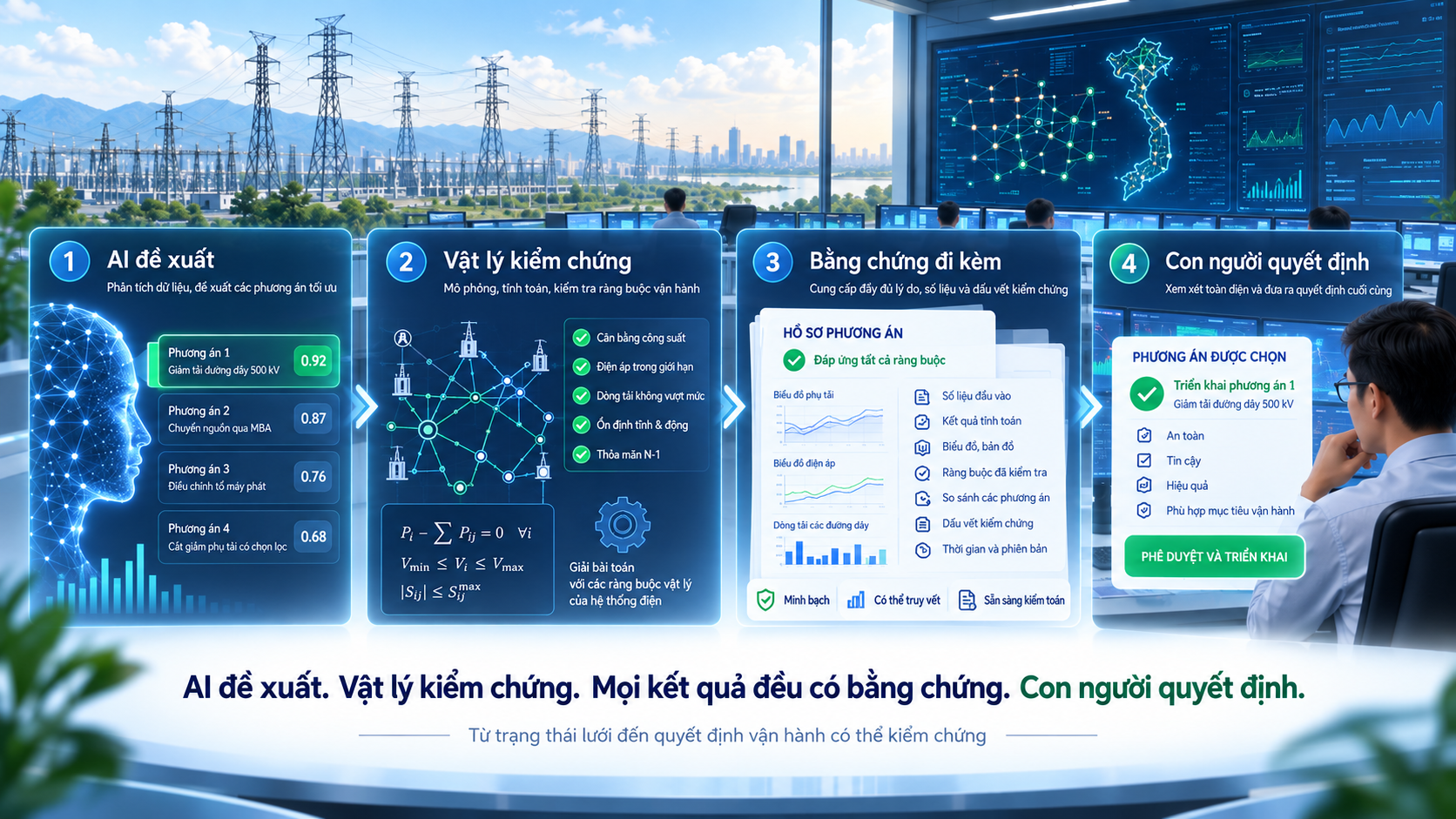
The architecture should therefore separate two layers clearly: AI proposes and physics verifies. AI may learn from history, dispatcher actions, PTDF/LODF, graph structure, or hundreds of thousands of snapshots. Before an option is considered feasible, however, it must pass through the solver and constraint checks.
This division of roles is practical. AI operates where it is strongest, while the physics solver independently verifies the option before it advances in the operational process.
5. From model-centric to situation-centric operations
An operational platform should not be organized around isolated AI models: one forecast model, one anomaly detector, one option-ranking model, and then an AI assistant. Dispatchers do not care how many models run behind the interface. They need a complete understanding of a grid situation that is occurring or may occur.
A complete operational situation must combine at least four layers: the current state, the expected state, active constraints, and feasible actions. AI should work from that shared context instead of allowing each model to see a separate fragment of data.
When the architecture becomes situation-centric, explanation becomes more natural. Dispatchers do not need a lecture on neural-network structure. They need to know which branch an option relieves, how much margin remains, whether it creates another violation, and which snapshot was used.
6. Agentic AI can orchestrate tools without owning the decision
Agentic AI makes the problem more interesting because AI no longer only answers questions. An agent can select tools, query data, invoke a solver, compare options, generate reports, and prepare a workflow for operator review.
Tool orchestration is valuable, but the ability to call the right tool does not grant decision authority. These responsibilities must remain separate in the architecture.
Allowed actions
Query state, run simulations, generate candidates, compare results, and prepare drafts.
Bound by
Approved tool lists, role-based access, state checks, operational policies, time limits, and approval gates.
No autonomous authority
A recommendation cannot become a field action without the required authority and verification results.
7. Every recommendation must carry verifiable evidence
A sound recommendation in a critical system should carry more than a score. It needs enough evidence for another engineer to review, verify, and reproduce the exact situation that produced it.
State provenance
Which snapshot, timestamp, topology version, and dataset were used?
Model provenance
Which model and version generated or ranked the option, with what confidence and applicability?
Physics results
Load flow, violations, security margins, and contingencies before and after the action.
Sequence verification
For multi-step actions, intermediate states must be retained and verified.
Human decision
Who changed, rejected, or approved what, why, and when?
Reproducibility
Can the situation be reconstructed for review, audit, or post-event analysis?
This is also what many AI demonstrations lack. A system may respond fluently, but without an adequate trail its answer cannot become a trustworthy part of an engineering process.
8. The Operational Digital Twin anchors AI to reality
For AI to understand the same state a dispatcher sees, the grid first needs a unified representation. This layer may be organized as an Operational Digital Twin. It is not a visually appealing 3D model; it is a computable digital state with topology, power-system semantics, measurements, and operational limits.
When every snapshot can be reloaded, solved again, replayed under contingencies, and compared with historical results, the same platform supports both AI development and AI verification.
The Operational Digital Twin is therefore the foundation that ties every AI analysis, recommendation, and decision to a specific grid state that can be verified again through computation.
9. An architecture suited to real operations
When building an AI platform for grid operations, the starting question should not be which LLM to choose. First define the decision chain, trusted reference state, computation layer, role of AI, and approval boundaries.
Principles that should remain hard constraints
- Do not let AI certify physical correctness. Managed grid state and verifiable calculations are the basis.
- Do not substitute model confidence for verification. Model confidence and electrical feasibility are different.
- Do not check only the final state. Intermediate states in a switching sequence must also be safe.
- Do not hide uncertainty. The system must report poor data, out-of-distribution states, or solver non-convergence.
- Do not let an AI agent exceed its authority. Tools, action scope, and approval gates must follow operational roles.
- Always preserve reproducibility. Important recommendations must be reconstructable from the data, model version, and calculations used.
- Maintain a path when AI is unavailable. Core operational capability must continue even if AI stops.
The goal should not be an all-knowing “virtual dispatcher.” AI is better used as an intelligent support layer that helps humans process a larger state space more quickly and with stronger evidence.
10. Where does the real operational value lie?
The value of this approach is not automation at any cost. It lies in helping operators see emerging states sooner, explore more options in less time, verify each option on the same grid model, and preserve the basis for a decision.
AI does not diminish the dispatcher’s role. It improves context, expands analytical coverage, and shortens the path from detecting a problem to selecting an executable option.
This is the distinction between an AI demonstration and a platform with operational value. A demonstration often stops at an answer. An operational platform must complete the chain from state and computation through recommendation, verification, evidence, and decision.
11. Conclusion
The difficult part of grid AI is not making a model propose an option. It is placing that proposal inside a process where the grid state is explicit, feasibility is verified, evidence is retained, and decision authority is unambiguous.
AI should reduce the search space, learn from history, recognize patterns, connect tools, and deliver the right information to the right person. Physics calculations keep the system anchored to reality, evidence makes each decision reviewable, and dispatchers retain final authority.
The core principle can be stated simply:
AI proposes. Physics verifies. Every result carries evidence. Humans decide.
That is how AI should enter the control room.